



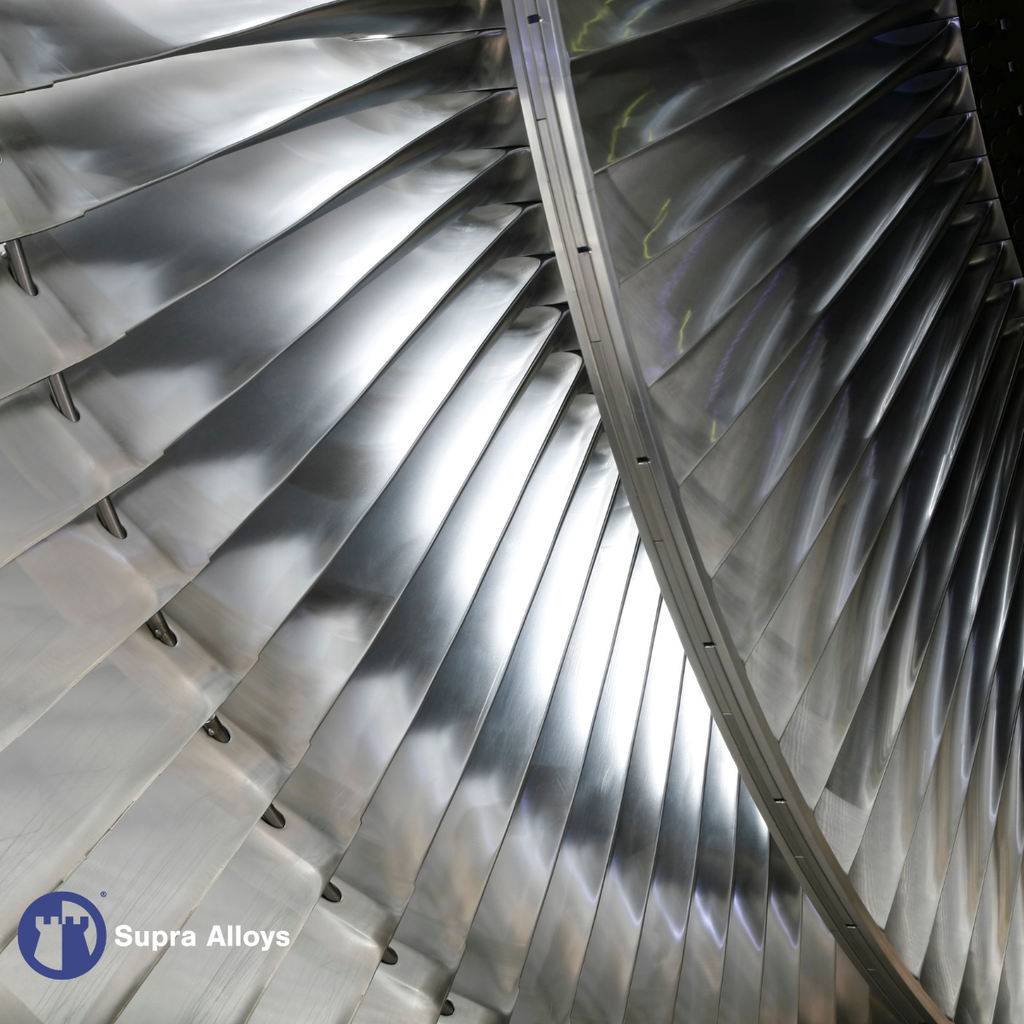
Flight-critical aerospace components require materials selected through careful engineering, qualification, and specification control. Titanium remains an important option because it combines high strength, relatively low weight, corrosion resistance, and dependable performance in demanding aerospace environments.
Titanium may be specified for applications such as:
- Structural aircraft components
- Turbine disks
- Turbine blades
- Landing-system hardware
- Aerospace fasteners
- Engine-related assemblies
- Precision-machined fittings
- Space and defense structures
Supra Alloys supplies commercial and aerospace customers with stocked commercially pure titanium and titanium alloys. Its titanium inventory includes bar, rod, wire, coil, sheet, and tubing.
How Does Titanium Support Aerospace Performance?
Aerospace designers regularly evaluate ways to reduce component weight while maintaining structural performance. Titanium’s strength-to-weight characteristics make it a candidate for applications that require both strength and controlled mass.
The aerospace information from Supra Alloys identifies Ti-6Al-4V for spacecraft frames, landing gear, and rocket engines. The company also identifies titanium applications associated with fuel systems, thermal protection, fasteners, and vibration-intensive environments.
Titanium’s corrosion resistance can also support components exposed to demanding service conditions. The precise benefits depend on the alloy, component design, manufacturing route, operating environment, and applicable specification.
Why Must the Titanium Grade Match the Application?
Titanium is a family of commercially pure grades and engineered alloys rather than one universal material. Supra Alloys lists commercially pure Grades 1, 2, 3, 4, 7, and 11, along with Grade 5 Ti-6Al-4V, Grade 23 Ti-6Al-4V ELI, and Grade 12 titanium alloys.
These options provide different combinations of strength, corrosion resistance, formability, and manufacturing characteristics. Aerospace engineering and quality teams should identify the exact grade, condition, form, specification, inspection, and certification requirements before placing an order.
How Can Titanium Processing Simplify Manufacturing?
Titanium may require cutting or other preparation before reaching the customer’s production operation. Supra Alloys offers in-house saw cutting, shearing, custom strip slitting, chemical milling, and waterjet cutting.
Chemical milling supports controlled material removal and off-standard gauge requirements. Saw cutting and waterjet processing can prepare titanium to customer-defined dimensions before additional aerospace manufacturing begins.
These services give customers an opportunity to unite material sourcing and initial preparation. The selected process should reflect the titanium form, dimensions, tolerance, specification, and ultimate component requirements.
How Do Certifications Support Aerospace Sourcing?
Supra Alloys identifies AS9100D and ISO 9001 certifications on its official website. The company also states that its titanium products pass through its quality-assurance plan.
Manufacturers should identify all testing, certification, traceability, marking, packaging, and documentation requirements in the request for quotation.
Request an Aerospace Titanium Quote
A complete RFQ should include the titanium alloy, grade, condition, specification, dimensions, quantity, processing, testing, certification, traceability, packaging, and delivery requirements.
Contact Supra Alloys at www.supraalloys.com to request a quote and discuss aerospace titanium inventory, saw cutting, chemical milling, waterjet processing, and documentation requirements for your next flight-critical component program.